

Strengthening of Global Climate Regulations and Structural Transformation of South Korea's Emissions Trading System
As the response to the global climate crisis accelerates, greenhouse gas reduction has now gone beyond selective environmental management and established itself as an essential requirement for survival. The government of the Republic of Korea has set a challenging 2030 National Greenhouse Gas Reduction Target (NDC) of 40% reduction compared to 2018 levels, and is operating the Greenhouse Gas Emission Trading System (K-ETS) as a key mechanism to achieve this. In particular, the 4th planning period (2026–2030), starting in 2026, signals a level of regulation and structural changes incomparable to previous planning periods. These changes are simultaneously placing a massive cost burden and pressure on efficient process operations on key domestic industries with high carbon emissions, such as steel, petrochemicals, and semiconductors .
Based on over 170 years of global operational experience in water, waste, and energy management, Veolia offers customized carbon reduction solutions to industry-specific clients to help them overcome these regulations and realize an 'Ecological Transformation'. We would like to provide strategic insights by comprehensively analyzing key policy changes during the 4th planning period, carbon emission status by industry, and Veolia's specific technical solutions.
Key Changes in the 4th Greenhouse Gas Emission Trading Scheme (K-ETS) Planning Period and Corporate Risk Analysis
The most fundamental change in the 4th planning period (2026–2030) is that the total allowable emissions will be reduced linearly and the proportion of paid allocations will be significantly expanded to ensure the effectiveness of reduction targets. This suggests that the cost burden companies must pay to purchase emission allowances in the market could increase exponentially.
Changes in the method of setting total allowable emissions and allocation units
The government has set the total allowable emissions for the 4th planning period at approximately 2.557 billion tons, which is a reduction of about 16.8% compared to the 3rd planning period. What is noteworthy is that, rather than the stepwise reduction of the past, a 'linear reduction method' has been introduced, which starts at 500 million tons in 2026 and reduces to 435 million tons in 2030 at a constant rate each year. Furthermore, as the allocation unit has been integrated from the existing individual 'facility' basis to the 'workplace' unit, overall energy efficiency management and emission optimization within the workplace have become even more important.
Expansion of the BM (Benchmark) Allocation Method and the Importance of Emission Efficiency
The BM allocation method, which grants more free allocation rights to companies with excellent emission efficiency, will be further strengthened during the 4th planning period. Previously, it was applied to 12 industries accounting for about 60% of total emissions, but in the 4th phase, the proportion is scheduled to be expanded to over 75%. In particular, processes such as semiconductor, display, nitric acid, and quicklime manufacturing are newly included or strengthened as targets for BM application, and the BM coefficient is also becoming strict enough to require achieving the top 20% level of efficiency by 2030. This means that companies that fail to improve carbon emission rates through technological innovation will face significant financial risks in the market.
Strengthening of market flexibility systems and sanctions
To ensure market liquidity, the carryover limit for emission allowances has been relaxed from three times the net sales volume to five times. This provides companies with an opportunity to strategically stockpile remaining emission allowances in preparation for future stricter regulations, rather than unconditionally selling them. On the other hand, as the upper limit on fines imposed for failure to submit emission allowances (previously 100,000 won per ton) has been removed, the legal and financial risks that companies must bear have become heavier if emission allowance prices skyrocket.

Carbon Emission Landscape and Process Innovation Trends by Major Industries
An analysis of the latest emissions statistics and the activities of major companies reveals that each industry faces different challenges.
Steel Industry: The Great Transformation of Coal-Based Processes and the Transition to a Hydrogen Economy
The steel industry is the largest emitter, accounting for a significant portion of South Korea's industrial sector emissions. Emissions from the steel industry in 2024 amounted to approximately 100 million tons, a slight decrease of 0.1% compared to the previous year, but this appears to be due to external factors such as a decrease in crude steel production.
➡️ Management of industrial water generated during large-scale facility conversion, waste heat recovery, and byproduct resource utilization, which is a key area that Veolia can best support.
Petrochemical and Refining Industries: Combining Energy Efficiency and the Circular Economy
Due to improved business conditions in 2024, emissions in the petrochemical industry recorded approximately 53.6 million tons, an increase of 4.4% compared to the previous year. The oil refining industry also recorded 20.8 million tons of emissions, a 6.1% increase due to increased exports. Reducing emissions is very difficult for these industries because they use fossil fuels as both raw materials and fuel.
Currently, the main response strategies of these industries are improving energy efficiency through process optimization and introducing circular economy systems.
➡️ Veolia is making a significant contribution to reducing carbon footprints by optimizing cooling water management and water reuse efficiency using digital tools at petrochemical complexes in Daesan, Ulsan, and Yeosu.
Semiconductor and Display Industry: Process Gas Reduction and Ultrapure Water Risk Management
In the semiconductor industry, the main issue is indirect emissions resulting from process gas (F-gas) treatment and massive power consumption, rather than direct emissions. In 2024, the semiconductor and display industries achieved significant reductions in emissions through measures such as expanding the operation of process gas reduction facilities. However, the surge in demand for ultrapure water due to the expansion of fabs is becoming a new challenge, and Samsung Electronics and SK Hynix have set goals to maintain water intake at current levels or increase reuse rates by 2030.
➡️ Veolia aims to solve the problems faced by its customers through optimized and advanced water resource management solutions.
Veolia's Core Integrated Solutions and Technological Differentiators
Veolia has over 100 customized solutions capable of significantly reducing carbon emissions in three areas: water treatment, waste management, and energy optimization.
Hubgrade: AI-based digital environment management platform
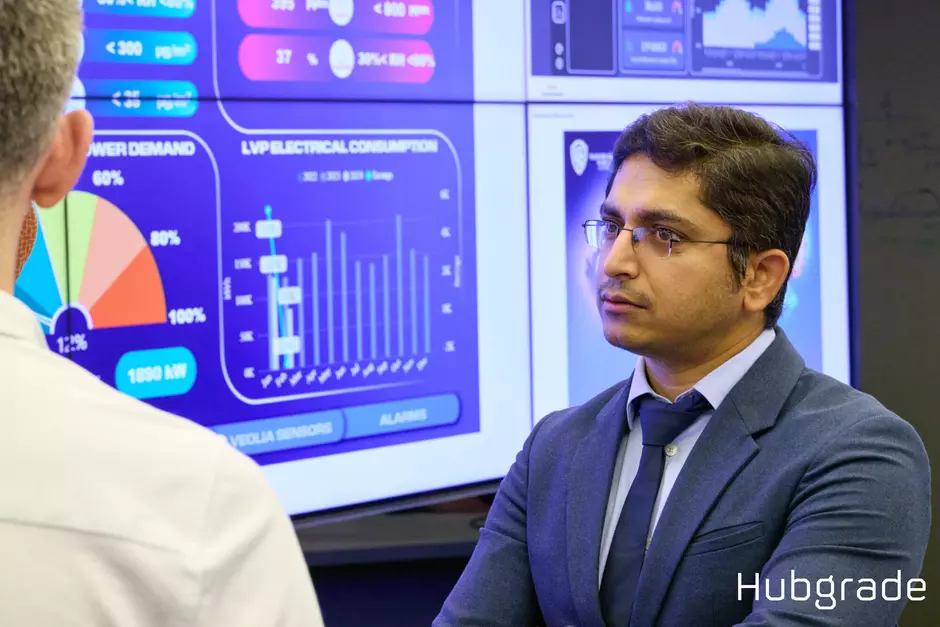
Veolia's core competitive advantage is its AI solution, 'Hubgrade'. Hubgrade identifies the optimal point for facility operations through real-time data analysis and reduces energy consumption by more than 20%.
Low-carbon water treatment solutions and circular water resource management
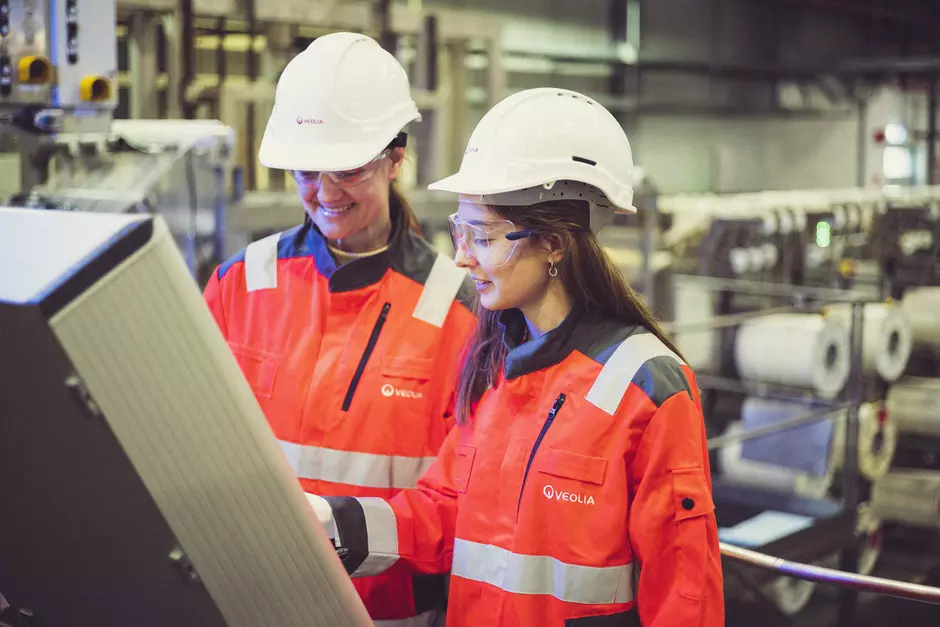
Water management and carbon emissions are closely related. Veolia provides solutions that maximize water reuse rates for industrial customers, simultaneously reducing water intake costs and carbon footprints. The Daesan Petrochemical Complex project achieved results in improving water treatment efficiency to 95% and reducing sludge generation by 20%. In addition, we provide sustainable water treatment solutions to customers in the semiconductor industry through long-term ultrapure water (UPW) supply and operation contracts.
Organic waste energy conversion and waste resource recovery solutions
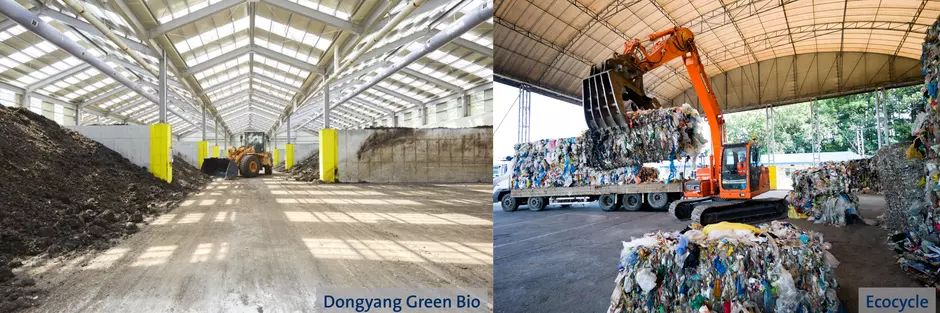
Veolia transforms waste into a sustainable energy source. Dongyang Green Bio in Bonghwa-gun, Gyeongbuk processes 120 tons of organic waste resources per day and produces approximately 29% of its energy consumption through the installation of solar panels. In addition, Ecocycle, located in Yeoju, Gyeonggi-do, provides its clients with an annual carbon reduction effect of over 80,000 tons through resource recycling by manufacturing and supplying approximately 80,000 tons of solid recovered fuel (SRF) made from waste plastics annually.
Veolia as a Partner in Ecological Transformation
The 4th Greenhouse Gas Emissions Trading Scheme planning period marks the dawn of an era where carbon emissions become both a core risk and a measure of competitiveness for companies. In this era of uncertainty, Veolia Korea provides reliable solutions through the stable operation of Hubgrade's digitalization and expertise in the fields of water treatment and waste management.
Veolia is more than just a service provider; we are a 'partner in ecological transformation' helping the Korean industrial sector safely enter a low-carbon economy.